Wednesday, June 27, 2007

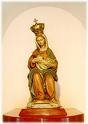
St. Clotilde - Icon of motherhood Part II


In 496, Clovis is at war, and losing the battle of Tolbiac. Desperate, he prays to the "God of Clotilde"; if he wins, he will convert to the Catholic church. The battle was won and Clovis is baptized on Christmas Eve 496 at Rheims by the bishop St. Remi. The story says that a dove descended from Heaven, bearing the Ampulla containing the sacred oil to anoint the Kings of France. Clotilde also received the banner of France, with three fleur-de-lys on it instead of three frogs. Three thousands of Clovis' soldiers, following his example, were also baptized that day.
Clotilde stood next to the baptismal font, spiritual mother to a whole nation.
Clovis decides to make Paris his capital and with Clotilde, he visits St. Genevieve. If Clotilde is the icon of motherhood, Genevieve is the icon of consecrated virginity; the beauty of both vocations represented for the glory of God and of his Church in France.
However, suffering was to be ever present in the life of Clotilde. When Clovis dies in 511, Clodomir becomes King, only to die in battle in 524. Here I have to be precise, for many a tale has sought to defame Clotilde's memory, presenting her as cruel and vengeful. History tells us otherwise, after the death of her son, she takes her three grandsons to be with her and care for their education. Her younger sons, Childebert and Clothaire, wanting to divide the kingdom between themselves, find and kill the two oldest sons of Clodomir. Only the third one escaped and entered a cloister to which he gave his name: Saint Cloud. The grief of Clotilde was so great, that she withdrew from Paris to Tours, where she could live a religious life, near the tomb of the great St. Martin.
Her only daughter had married the King of the Visigoths, Amalric. He so abused her, that she pleaded for her brother to rescue her. She died on her journey to join Clotilde, exhaused by the cruelty of her husband.
Soon, afterward, Childebert and Clothaire made war on each other for the control of the realm. It is said that Clotilde threw herself before tomb of St. Martin and begged the Lord that such a crime be spared her and the house of Clovis.
She died after thirty-eight years of widowhood, purified by the sufferings of motherhood, knowing that, as Catholic mothers, our place is often with Our Lady of Sorrows, at the foot of the Cross.
St. Clotilde, pray for us

Tuesday, June 26, 2007

Steninge Castle

This post is for Elena Maria Vidal from Tea at Trianon and all the fans of her blog (and I am one) who have followed her well informed posts on the background story of Count Axel von Fersen and Marie-Antoinette. In 2004, I visited the beautiful Steninge Castle in Sweden. The Castle is beautiful and the gardens enchanting. There is a glass factory nearby and it is close to the picturesque medieval town of Sigtuna.
It was also the property of the von Fersen family from 1736 to 1839. It is said that Marie-Antoinette and Louis XVI would have lived there, had they escaped to Sweden. After the murder of Count von Fersen by a brutal mob in Stockholm, 1810, a monument to his memory was build on the Castle grounds in 1813.

His beloved sister, Sophie wrote his epitaph: "To an unforgettable brother, the courage in his last moments on the 20th of June, 1810, bears testimony to his virtues and clean conscience."

I will continue the story of St. Clotilde tomorrow.

Monday, June 25, 2007

St. Clotilde - Icon of motherhood Part I


I missed her Feast day, June 3rd, but I have a special fondness for the extraordinary saints from this much maligned period of history called the Middle-ages. The medieval era opened with a woman and a saint named Clotilda.

She was a princess, her parents ruling over Burgundy. Her family was Catholic; this is important because most of the barbarian kings at the time were arians, they denied the divinity of Christ. Her own mother was said to be a remarkable woman herself and schooled her in the truths of the Catholic faith. After the death of her father, her uncle Gondebaud, who was arian became King of Burgundy. Despite the pressure that she must have encountered, she remained faithful to the Church.

Clovis, the King of the Franks, having heard of her beauty, wisdom and royal descent, asked for her hand in marriage. Yes, said Clotilde, but to this yes she puts a condition: she must be free to practice her Catholic faith. She then left an arian nation for a pagan nation.

Clotilde gave birth to a first son, Ingomir and immediately asked for his baptism. Clovis accepted and the child was baptised by St. Remi in Rheims. However, he died suddenly a few days after. Mourning the death of her firstborn, Clotilde stated calmly to her furious husband:

"I thank Almighty God, creator of heaven and earth, who did to my indignity the honor of opening His Kingdom to the one I have given birth to. My soul is not crushed by the pain, because, I know, taken from this world in his baptismal innocence, my son contemplates the face of God". (translation mine, from "La femme au temps des cathedrales", Regine Pernoud, Editions Stock, 1980: p.14)

She gave birth to a second son, Clodomir and Clovis also agreed to have him baptized. This time, the child survived. Clovis had an heir, a Catholic heir. Clotilda would have three more children, Childebut, Clotaire and Clotilda.

However, Clotilda didn't not give up her goal of converting her husband, she prayed, she beseeched God, she spoke plainly to her pagan husband about the true God.

Her perseverance and faith would be rewarded...

Saturday, June 23, 2007

Solemnity of the Birth of St. John the Baptist


Since I am French-canadian, this is a very important Feast day as St. Jean le Baptiste is our patron saint. I have vivid memories of the bonfires lit up in the park next to our home during my childhood.


In the Church calendar, only three birthdays are celebrated: Our Lord, Our Lady and St. John the Baptist. All the other Saints are honored on the day of their death or birth in Heaven. Exceptions are Our Lady, who was without sin from her immaculate conception and St. John, who was cleansed from original sin in the womb of his mother, St. Elizabeth. The Council of Agde in 506 confirms this feast as one of the highest in the Church life. Three masses, like at Christmas, were celebrated on that day.


It is celebrated on the 24th and not the 25th because of the way romans calculated their calendars: Christmas is 8 days before the kalends of January, the birth of St. John the Baptist 8 days before the kalends of July and since June has 30 days, it gives us the 24th of June as the date for this feast. It is a feast of light, the longest day of the year (approximately). Bonfires are a tradition in many countries (including my native Quebec).

It also means that the days are going to become shorter until Christmas. "He must increase: but I must decrease" John 3:30.

St. John the Baptist is the saint of adulthood, of maturity. He shows us how to prepare the way of the Lord in repentance. His ministry is intimately linked to the sacrament of Baptism and to the sacrament of Reconciliation. Like him, we are also called as Christian parents to prepare the way of the Lord in our home (and sometimes it feels like preaching in the desert!), so that our children will recognize the Lord in their own life.


"...the Lord willed to announce to men His own coming through the Baptist, lest if He appeared suddenly, they would fail to recognize Him." - St. Augustine


For the domestic church, if you are not up to a bonfire in your backyard, decorating your door with lilies, St. John's wort and birch leaves is a nice way to mark the day of his birth. I also serve a barbecue (fire!) and corn on the cob that day, as my parents did.

Thursday, June 21, 2007

Virginity


This is certainly not a popular word in our time. It is ridiculed and thought to be "unhealthy" or "abnormal". And when there is contempt for virginity, contempt for marriage arises as well. Children are exposed to such thoughts from a very early age, sometimes at home or at school or through the medias. Once thoughts about sexuality have been distorted, it can be difficult to correct and lead to painful experiences.
At a time when marriage is under direct attack, I wonder if one of the root of the problem is the general disregard for virginity, even in the catholic world.
Virginity before entering marriage, but also virginity for the sake of the Kingdom. It is good to be reminded that consecrated virginity is objectively a higher vocation than matrimony (this does not make marriage "evil" and if it is the vocation to which we are called it is the best vocation for us).
A multitude of saints chose this state of life, with for example Our Lord and Our Lady. By the sacrifice they make in renouncing matrimony, they are witnesses to the Lord as our Bridegroom, to our hope of union with God for eternity, where marriage as it is known here will no longer exists. It helps us to see matrimony in its rightful perspective, for chastity is a call for everybody. Let us foster chastity, purity and great regard for virginity in our homes and let us not forget, for those who have fallen, the Mercy of Our Lord, always.
St. Aloysius Gonzagua (1568-1591) was known for his purity and his penances. He made a private vow of chastity at the age of 9 years old. His time was no less scandalous than ours, he just persevered through prayer and penance in offering his virginity to God. He is a patron saints for teenagers, this difficult time when pressure from the world, especially concerning sexuality can be hard to withstand. Today is his feast day.
"Father of love, giver of all good things, in Saint Aloysius you combined remarkable innocence with the spirit of penance. By the help of his prayers may we who have not followed his innocence follow his example of penance. Grant this through our Lord Jesus Christ, your Son, who lives, and reigns with you and the Holy Spirit, one God , for ever and ever."
Collect for the Feast of St. Aloysius

Wednesday, June 20, 2007

Georg Philipp Telemann 1681-1767


I love good music and I particularly love Baroque music; Georg Philipp Telemann is one of my favorites. He was a prolific composer: 40 operas, 23 oratories and masses, over 1500 cantatas, etc. For 46 years, he provided music for the five main churches of Hamburg. In his time, he was more popular than Bach, however this didn't seem to darken their relationship since Bach asked him to be godfather to his son Carl Philipp Emanuel Bach. He was also a good friend of George Frederic Handel. Telemann was instrumental in helping to create the Classical style

He was born in Magdeburg, Saxony and discovered music at a young age, writing his first opera at 12 years old. His family did not approve and his instruments were confiscated by his mother. However, his talent could not be silenced (!) and at 17 years old he was noticed by a Jesuit monastery and was put in charge of their music. He became an intimate friend to Fr. Crispus, the Jesuit superior.

He moved to Leipzig to study law, but music was too great a passion and he became of full-time composer. His family life was not as successful: he lost his first wife in childbirth and his second wife left him for another man. He died on June 25, 1767.

Ordinary Time


The life of the Church follows two cycles: in the Temporal cycle, the life of Christ is relived in liturgical time; in the Sanctoral cycle, the emphasis is on Mary, the Mother of God and then the saints and martyrs of the Church. The year is divided in season: Advent, Christmas, Lent, Easter (finishing after the Octave of Pentecost) and Ordinary Time.

Following the seasons of the Church and the Temporal and Sanctoral cycle is a great way to enrich life and faith in the domestic church. The life of the domestic church should not be limited to the great Feasts of Christmas and Easter! Actually, by living each season well, we will appreciate them with even more depth.


We are right now in Ordinary Time, the longest season, the season of growth and maturity, symbolised by the color green. Basking in the Glory of the Resurrection, strenghtened by the Holy Spirit, we are ready to grow in holiness. It is then a wonderful time to practice the truths of the Faith in daily life.


Here are some suggestions to live Ordinary Time in your home:

- I love to put candles on the table at dinner time and I choose the color according to the season, to honor a Our Lady or a saint. Right now the color is green. Children really like changing the colored candles with the season or a special feast.

- It is a great time to establish a regular pattern of prayer in personal and family life and persevere in it.

- Celebrate the solemnity or feast day of the saints and Our Lady, for they are bountiful during the summer. In July: St. Thomas the Apostle, St. Maria Goretti, St. Benedict, Bl. Kateri Tekakwitha, Our Lady of Mount Carmel, St. James, St. Bridget,....
- Meditate on the Luminous Mysteries when saying the Rosary.

- There is more leasure time during summer, so why not start a good spiritual book, Sacramentum caritatis for example (the cover is green, so you can keep the color scheme going).

- Planting a garden and having the little ones help is a wonderful way to introduce them to the first chapters of Genesis as well as having fresh food for the summer.